

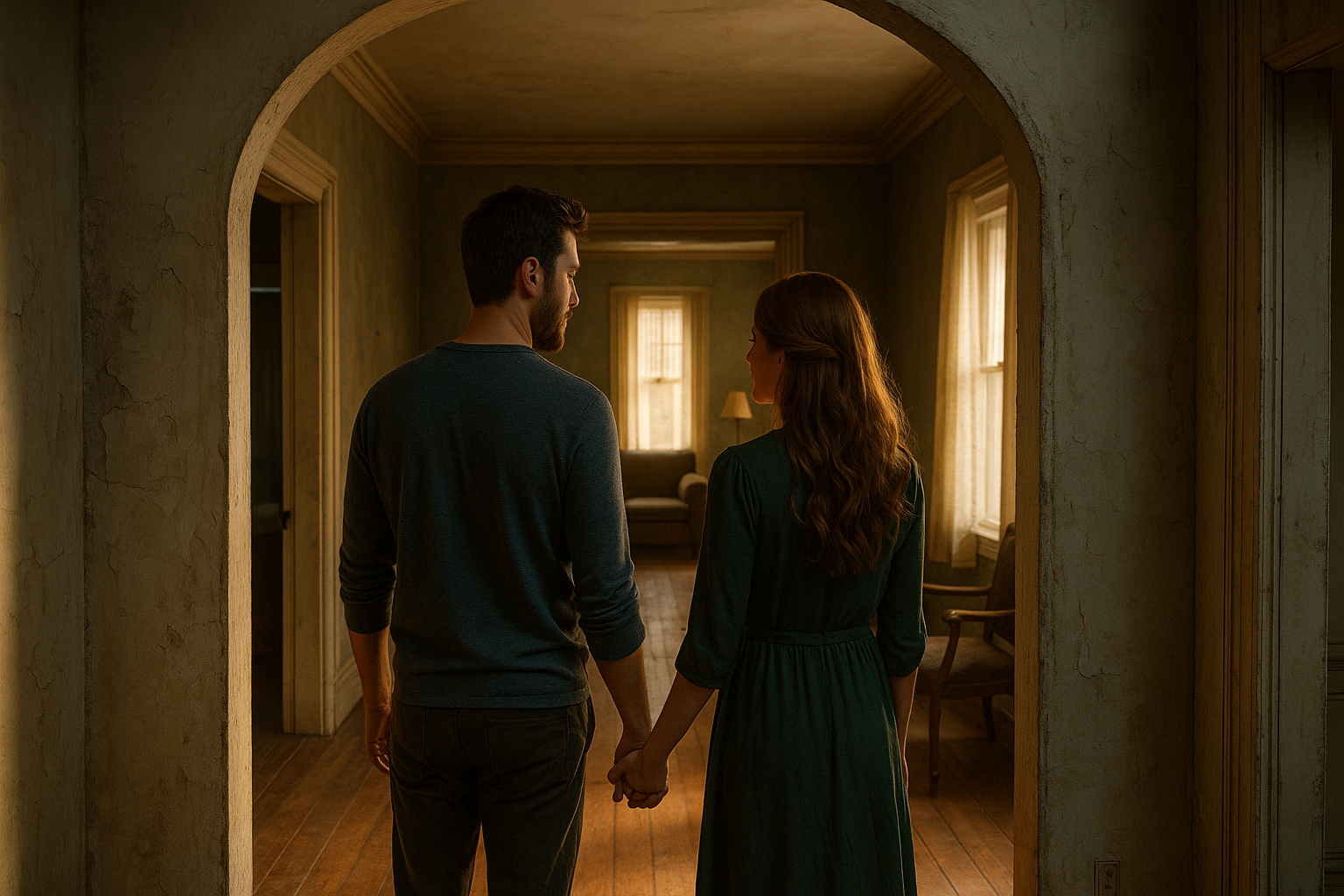
The first time the hallway moved, Claire thought she was imagining it.
She had just come home from work, keys still warm in her hand, mind still tangled in unfinished emails and half-decisions, when she noticed the living room door wasn’t quite where it usually was.
Not dramatically off.
Just… slightly.
“Did you move the door?” she called out.
From the kitchen, Thomas laughed.
“I’ve been chopping vegetables for half an hour,” he said. “I think we’d have noticed if I remodeled the house.”
She stood there, staring at the frame.
“I swear it’s supposed to be closer to the window,” she muttered.
Thomas leaned out and looked.
“It’s fine,” he said with a shrug.
But when he turned away, his eyes had narrowed a little.
They’d lived in the house for five years.
A modest two-bedroom tucked between quiet neighbors and trees that lost their leaves too early every fall.
They knew every creak.
Every floorboard.
Every place where the faucet dripped if you didn’t turn it just right.
It had always felt stable.
Reliable.
A reflection of them.
Lately… not so much.
The next shift happened three days later.
The bedroom felt smaller.
Not in a suffocating way.
More like the walls had leaned inward overnight to listen.
Claire noticed because she reached for the window and hit the wall instead.
“That wasn’t there,” she said quietly.
Thomas paused.
“It’s a wall,” he replied gently. “They don’t move.”
She wanted to believe him.
But the house felt different.
Like something inside it had started paying attention again.
They had been avoiding each other.
Not aggressively.
Not with shouting or slammed doors.
Just the quiet avoidance of two people trying not to disturb the fragile routines that kept them functioning.
Meals had grown shorter.
Touches had grown absent-minded.
They still shared space.
But they didn’t quite share air anymore.
Then the kitchen shifted.
Not the room itself.
The table.
Not enough to send plates sliding.
Just enough to leave a narrow gap where Claire used to sit.
She stared at the empty space.
As if the house had created distance for them.
Or maybe had simply mirrored the one they had already built.
“What’s happening to this place?” she asked one night.
Thomas stood beside her.
He didn’t answer right away.
He just stared around the room.
“It feels like it’s… reacting,” he finally said.
“To what?” she whispered.
He looked at her then.
Not sarcastic.
Not defensive.
Just honest.
“To us,” he said.
They didn’t talk about it much after that.
Not because they didn’t believe it.
But because it felt too precise.
Too targeted.
Too uncomfortable.
The house wasn’t breaking.
It was responding.
One evening, after a long silence-filled dinner, Claire walked the length of their living room.
It felt longer.
Not by distance.
By emptiness.
She stood near the center.
“I don’t remember the last time we chose each other on purpose,” she said quietly.
Thomas didn’t respond.
He was staring at the far wall, now farther than it had been yesterday.
“I think we just assumed,” he said.
“That the choosing part was over.”
She nodded.
“And the house is correcting us,” she whispered.
That night, the hallway narrowed.
Not sharply.
Gently.
As if asking them not to drift too far apart.
They bumped into each other on accident — a shoulder, a hand — and for a brief second, neither pulled away.
“Are you angry with me?” Claire asked him later.
“I think I’m more afraid of losing you slowly,” Thomas replied.
He didn’t look at her when he said it.
But she heard everything in his voice.
“And I think,” she added softly, “I’ve been pretending not to notice it because saying it made it real.”
He turned to her.
“And not saying it made it happen,” he replied.
The house creaked.
Low.
Not threatening.
Acknowledging.
The next morning, the bedroom had stretched.
Not away.
But outward.
Like it had taken a slow breath.
More light entered the window.
More air.
Claire reached for Thomas’s hand on instinct this time.
He let her.
Didn’t hesitate.
Didn’t question.
“What if we start choosing each other again?” she asked.
“Not automatically.
Not by habit.
But consciously.”
He looked at her for a long moment.
Then nodded.
“Then maybe the house remembers how to stand still again,” he said.
Small choices.
Not grand gestures.
Not flower-filled apologies or theatrical promises.
Just…
He listened instead of retreating.
She asked instead of assuming.
They spoke instead of swallowing.
They sat together even when silence felt awkward.
Especially then.
Each time they chose each other deliberately, something shifted.
The hallway straightened.
The kitchen table aligned.
The bedroom widened with soft air.
It wasn’t instant.
It wasn’t theatrical.
It was slow.
Lived-in.
Real.
One rainy afternoon, as they sat on the couch, shoulders touching like it had never felt dangerous to do so, Thomas laughed softly.
“You ever think this house just didn’t want to be alone either?”
Claire smiled.
“I think,” she said, “it just wanted to see if we remembered how not to be.”
Months later, the house stood exactly the way it always had been.
Dimensions restored.
Angles familiar.
Sturdy.
But somehow…
Warmer.
Not because of design.
Not renovation.
But because now, the air inside it carried intention again.
Not just routine.
One evening, as they stood in the doorway together, Claire rested her head against his shoulder.
“Did it ever scare you?” she asked.
“The moving?” he replied.
She nodded.
He thought for a moment.
“No,” he said.
“It just made it impossible to pretend anymore.”
She smiled.
“And once we stopped pretending,” she whispered…
“Something else finally stopped moving too.”